Who Is the 50 Year Old That Just Had a Baby
T o gloat reaching half a century, Gemma Barnes wrote a list of the 50 things she hoped to achieve. Topping it was an appetite that a few years ago would have seemed cool: she wanted to have a baby. But two years on, Barnes is cuddling her 8-calendar month-old girl, and while that means most of the other 49 ambitions will have to wait, she is delighted to exist a mother.
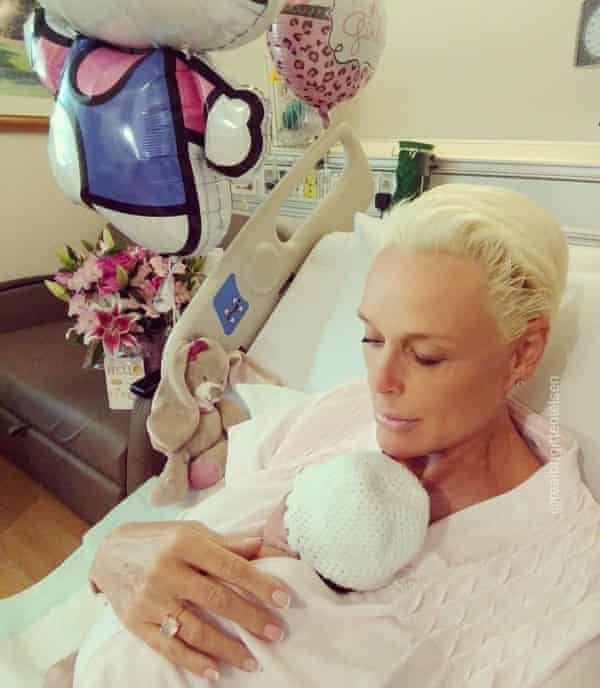
Barnes'southward situation is unusual, but she is certainly not lonely. In June data published by the Office for National Statistics showed the number of births to l-plus women has quadrupled over the last two decades, up from 55 in 2001 to 238 in 2016. During that menstruation there were i,859 births in the UK to women over 50, and 153 to women over 55. Flying the flag for older maternity have been a host of celebrities, most recently player Brigitte Nielsen who was 54 when her fifth child, a daughter named Frida, arrived this summer. US vocaliser Janet Jackson gave nativity in January, aged fifty, to son Eissa. Maybe virtually visible of all has been Us Senator Tammy Duckworth, an Republic of iraq veteran who lost both legs when her helicopter was shot down in 2004. She gave nascence earlier this twelvemonth, also aged fifty, and was photographed soon subsequently, protesting against Trump's clearing policies while holding newborn Maile on her lap.
For Barnes, a single mother who lives in London, a babe was always on the horizon but past the end of her 40s several attempts at IVF had failed and the human relationship she was in had ended. "I thought, I don't accept time to find someone else, I'g going to take to do it on my ain," she says. Under National Institute for Health and Intendance Excellence (Nice) guidelines, women over 42 don't authorize for NHS-funded assisted conception, so Barnes found a private clinic willing to treat her – but the kickoff round of IVF, using sperm from a donor, failed. Then came a conversation that would alter everything. "I said to the doctor, 'Tell me honestly, what are my chances of having a infant at my historic period?' And he said: 'With your own eggs, less than ane%. But if you're willing to use eggs from a donor, they go up to around 60%.'"

At outset, Barnes wasn't sure whether she wanted to go downwards that route. "You want your baby to be yours. I was thinking, would she look like me? Would she have my nose? My pilus colour? Only the medico started talking nigh how when you carry a baby you shape so much about his or her personality and behaviour during the pregnancy. I started to recollect that was right, and that conveying the child was very of import."
Having made the decision to go alee, there was an egg donor as well as a sperm donor to choose. "Y'all do it all online and it seems a bit surreal, and yep, you practise retrieve y'all're playing God. These two people will never meet, never know one another, and together their cells volition create a baby – your infant. It felt a huge responsibility, especially as I was making decisions all on my own."
Philippa Hodgson, who is 58 and the female parent of a 4-year-old, was similarly unsure at first about whether to utilize an egg donor, simply like Barnes went ahead when she realised it would give her the best risk of a baby. She had met her married man when she was 45; her girl Roxanne was conceived using his sperm and a donor egg. "I was very shocked at first by the idea that nosotros could use some other adult female'south egg," she says. "I felt my child wouldn't really be my own. Only now she's here I couldn't love her more. Occasionally she does something that I don't recognise as being connected to either my husband or myself and I think, how beautiful – that must exist because of something in her genes from the donor."
Despite being reconciled to using a donated egg, though, neither Barnes nor Hodgson has told everyone in their lives about that chemical element of their story, and nor has the third female parent I spoke to, Ballad, who is 61 and has children aged 13 and 10. (Barnes and Hodgson are pseudonyms; Carol is happy to use her first proper noun.) Carol'south feeling is that her determination to use an egg donor is not secret information, merely it is private – and it would invade her children's privacy to broadcast information technology to the earth. All three women, incidentally, are entirely committed to telling their children how they were conceived. Hodgson says she talked to her little girl recently about it: "I told her that a kind lady gave me an egg because mummy couldn't use her ain eggs. And she replied, 'You are my only mummy.' I was gobsmacked."
All the same, some professionals working in the field of later-life pregnancy are concerned about what Nina Barnsley, director of the Donor Formulation Network, which supports families with children born as a event of donated gametes, describes as a "fog" effectually the field of study, because so few women feel able to exist open about egg donation: "It's still a taboo. Many older mothers feel they are up against it enough in terms of other people's views, and being open nearly this would be something else to criticise them for." Celebrities, meanwhile, are ofttimes coy most the precise details of how they conceived, giving rise to the misconception that young people tin can postpone pregnancy until their sixth decade. "As a order nosotros need to have a proper conversation," says Barnsley. "The technology means it's possible to have babies until we're 75 – but is that what we want?"
Adam Balen, professor of reproductive medicine at Leeds Academy and fertility spokesperson for the Royal College of Obstetricians and Gynaecologists, shares Barnsley's concerns. "We're not very practiced in the w at preventative medicine, and in the world of infertility we are treating lots of things that could have been prevented," he says. If IVF has the reputation for being a panacea then that, he stresses, is misplaced. "IVF doesn't piece of work for anybody, and it'due south non available on the NHS for everyone." As well every bit existence expensive (some of the women I spoke to accept spent upwards of £20,000 on their quest for a baby, and anecdotally others take spent far more than), late pregnancy carries risks, says Balen. Miscarriage and pre-eclampsia, in particular, are more likely; and the use of donated gametes increases those risks. Stresses around assisted conception can as well touch on a human relationship.
Both Ballad and Hodgson take been mistaken for their child'due south grandmother; but all iii women say they expect a lot younger than their years and that few other mothers seem to clock that in that location is annihilation unusual virtually their family unit. Perhaps, Barnes muses, it takes a woman who feels younger than she is to dive into late motherhood.

For Gemma, being older didn't mean bitter her nails with worry through the pregnancy. "Because the egg was from a younger donor, the risks aren't so groovy. I felt fantastic throughout. I concentrated on staying calm, on connecting with the baby growing inside me." Most older mothers are brash, every bit she was, to accept a caesarean. "It was a very piece of cake birth: information technology took 10 minutes to get her out, and one-half an 60 minutes to stitch me up. And of course coming together her was so wonderful – I'd waited a long fourth dimension for that moment."
For Carol, though, pregnancy was a scary time. "I had miscarried in the past and knew I had a college take a chance of miscarrying considering of my historic period. I felt I had so much to lose – information technology was never going to be a question of 'you can give information technology another shot' the way it would be for a younger woman," she says. She developed pre-eclampsia towards the terminate of her get-go pregnancy and both her babies were born by caesarean. Unlike Barnes, she found that a "very peculiar" feel. In one case her babies had arrived, though, she loved the early weeks and months with them. "I felt I appreciated them in a mode that you perhaps only do with something that hasn't been easy," she says. She struggles to think of any fashion existence older has disadvantaged her children.
"I know plenty of people much younger than me who don't seem to have much free energy," she says. "I think I exercise as much with my children equally the other mothers I know – I only recently stopped bouncing on the trampoline with them. I don't feel significantly different from when I was younger." And so, she says, at that place are the advantages. "I stopped working by the time I had children, and then I've been able to put all my time and free energy into their lives." Barnes works part-time, but feels she is able to devote more of her fourth dimension to her daughter Hannah (non her real name) than she could have done when she was younger. "I'chiliad in a much better place now than I was 20 years ago," she says. "I'one thousand very settled in myself, very content. I'k fitter than I've ever been, I've got enough money to be comfortably off and to provide for her. Hannah is everything to me and I don't have to prove myself."

Understandably, the women who are making information technology piece of work want to concentrate on the positives; they bat off whatsoever suggestions that in that location might be disadvantages. "I don't feel different from anyone else at mother and baby groups considering, quite simply, no one has any idea I'm older," says Barnes. "Having a infant is a neat leveller. When y'all're mixing with other parents it's all about them, how they're sleeping and feeding and so on. No one asks you how quondam you are." Carol is more than selfconscious well-nigh her historic period, perhaps considering she is at present in her 60s and has a child still at principal schoolhouse. "Telling people how old I am is always a bit scary: y'all retrieve, volition people see me in a different light? I'm very careful about who I share it with. I don't mind telling friends who have got to know me, just people I don't know are more likely to estimate me in a negative way."
She has likewise plant her ain needs squeezed between those of her children and her parents. "I had a very difficult phase where every time the phone rang I didn't know whether it would be someone calling from school to say my son needed me or someone calling to say i of my frail parents had fallen downwardly the stairs." And if her own parents accept had their experience of grandparenting curtailed, she knows that is likely to be repeated. "Volition I ever be a grandmother? I practise wonder nearly that." Meanwhile, she says, some of her friends are already grandparents. "It does seem a fleck strange, that we're the same age but in such different situations," she says.
Barnsley has some concerns about the trend. "Fiftysomething motherhood volition only ever be a choice for the well-off," she says. "And some women volition spend a lot of money on something that doesn't, in the end, work out. Imagine borrowing £50,000 and and then being unsuccessful." She also wonders where the kid'southward perspective is in the debate. "I'm thinking of 21-year-olds who instead of travelling the world volition be looking later on a parent with Alzheimer's," she says. "They run the gamble of being out of sync with their peers, and that might not be easy." (This is too, of class, the case for men who have children in their 50s and over, although that is less rarely raised as an issue.)
Barnes believes later-life maternity will become much more common and she welcomes it. "The only two disadvantages, as I see it, are genetics – ie your child doesn't share your genes – and the take chances of dying while your children are still young." Similar Hodgson, she found the genetic issues faded into the background once her baby appeared, although she does sometimes worry about Hannah's medical history, and what she might not know about it. In the future, she thinks young women will exist encouraged to freeze their eggs for afterward apply, as is currently being debated; but at nowadays in the UK human eggs can normally only exist frozen for a decade, and fertility specialists say eggs from a woman's 20s and early on 30s would give her the best chance of a child in her 50s. So for egg freezing to be useful, the police force would have to change – and some fertility clinics would similar to see that happen. Other countries have different guidelines and legislation around fertility, and some British women travel to Kingdom of spain, Republic of cyprus and India in the hope of making it easier for themselves.

1 thing everyone seems to be in agreement on is that it would be better for young people in detail, and the whole population in full general, to know more about fertility. Hodgson wishes she had learned more than almost it at school. In his function as chair of the British Fertility Guild, Balen has called for the curriculum to be widened to teach young people about how to achieve pregnancy, also as how to avoid it. And however, ane major reason women are tending to exit pregnancy until their 30s is for economical reasons: most twentysomethings can barely beget to pay the hire, let alone provide for a family. Workplace pressures on thirtysomethings to get promoted and zip up the career ladder is another factor weighing against younger motherhood; and however well-informed teenagers become about fertility, there is no guarantee they volition meet the person they want to raise a child with before the age of 35.Kamal Ahuja, scientific director of the London Women's Dispensary, which treats women up to the historic period of 50 but makes occasional exceptions for over-50s, says that while any doctor would propose childbearing in a adult female'south 20s or early 30s, the emotional, fiscal and social realities, added to the fact that human being beings are living "stronger, longer and with greater ambitions" mean the tendency is near certainly set to grow. He predicts that medical advances will brand it easier and cheaper in the years ahead.
Gemma Barnes, meanwhile, hasn't written her to-exercise list for her 52nd altogether, which is coming upward after this year. But when I ask her what's going on it she smiles broadly and says she is definitely not ruling out a blood brother or sister for Hannah.
Source: https://www.theguardian.com/lifeandstyle/2018/aug/21/becoming-mother-in-50s-number-births-soaring
0 Response to "Who Is the 50 Year Old That Just Had a Baby"
Post a Comment